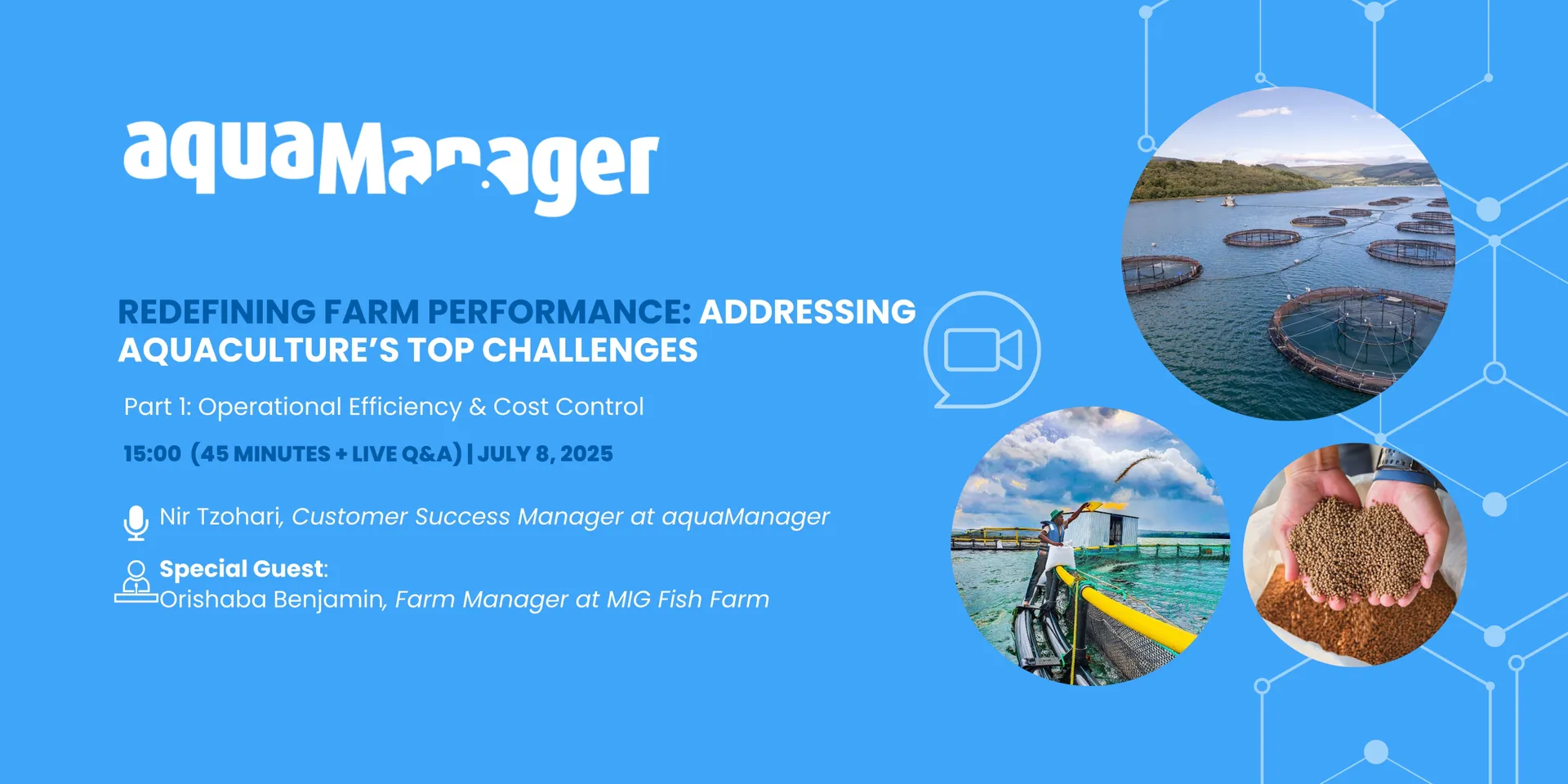
Thank you for joining our recent webinar, “Redefining Farm Performance: Addressing Aquaculture’s Top Challenges – Part 1: Operational Efficiency & Cost Control.”
Below, you’ll find answers to the unanswered session’s questions during. These reflect common concerns from aquaculture professionals around the world who are striving to scale operations while managing costs, feed, and labor more effectively.
If you don’t see your question here or would like to explore your own farm’s needs further, you can also request a free operational audit here.
Frequently Asked Questions
- Is the 1.2 eFCR value cumulative from stage to stage until harvest—for example, from nursery to grow-out—or does it apply to a specific production stage only? What’s your typical planting and harvest size?
→ The 1.2 eFCR refers to the entire production cycle, covering all stages from nursery to harvest. - What are the most effective and sustainable strategies to protect fish farms in Lake Victoria from predators, while maintaining ecological balance and keeping costs manageable for small-scale aquaculture operations?
→ One of the best approaches is to use double nets: a stronger outer net made with large mesh and thick twine, combined with an inner net suitable for the size of the fish. It’s important to ensure neither net gets clogged. - More broadly, what predator protection methods work best for small-scale fish farms, balancing sustainability, environmental impact, and affordability?
→We typically face two categories of predators: Aquatic predators like otters — For these, we recommend using double netting: a strong outer net with a larger mesh and thicker twine, combined with a finer inner net suitable for the size of the fish. This creates a barrier that’s difficult for predators to breach. Surface predators like birds — To protect against them, it’s best to install cover nets with fine mesh over the top of the cages. This prevents birds from accessing and picking fish from the surface. - Both methods are effective, affordable for small-scale farmers, and importantly, non-harmful to the predators, ensuring ecological balance while safeguarding the stock.
- What role does an aquaculture management system play in helping small-scale farmers optimize the use of technology, manage costs, explore payment options, and share resources collaboratively?
→ A good management system supports farms of all sizes. By consistently recording daily activities, farmers can analyze performance and get recommendations tailored to their needs. This helps optimize operations without needing large budgets or technical staff. - What is the typical cost for a small-scale farmer to access and implement this kind of technology?
→ For small, single-site operations, costs start at just a few euros per day. Pricing varies based on your specific setup, so it’s best to contact our consultants for a tailored estimate. - What types of sensors are being used to provide real-time data, especially during nighttime? Do you rely on continuous monitoring systems or daily water probes?
→ Dissolved oxygen (DO) and temperature sensors—typically optical—are highly recommended. These can be used for continuous monitoring, which allows farms to track trends and act early in case of oxygen drops or other risks. - What specific records should a smallholder commercial fish farmer maintain for effective farm management and traceability?
→ Farmers should consistently log all daily transactions: fish stocking, mortalities, feeding, transfers, harvests, and any measurements. These records serve as a reliable reference for performance evaluation. - The simplification of bottom-up data sharing is a valuable approach. Do you perform integrity checks on this data before using it for analysis and decision-making?
→ Yes. It’s strongly recommended to double-check data for accuracy before saving it to the system. Simple validation steps can help avoid typos and ensure decisions are based on reliable information.
If you weren’t able to join us live, you can watch the full recording below: