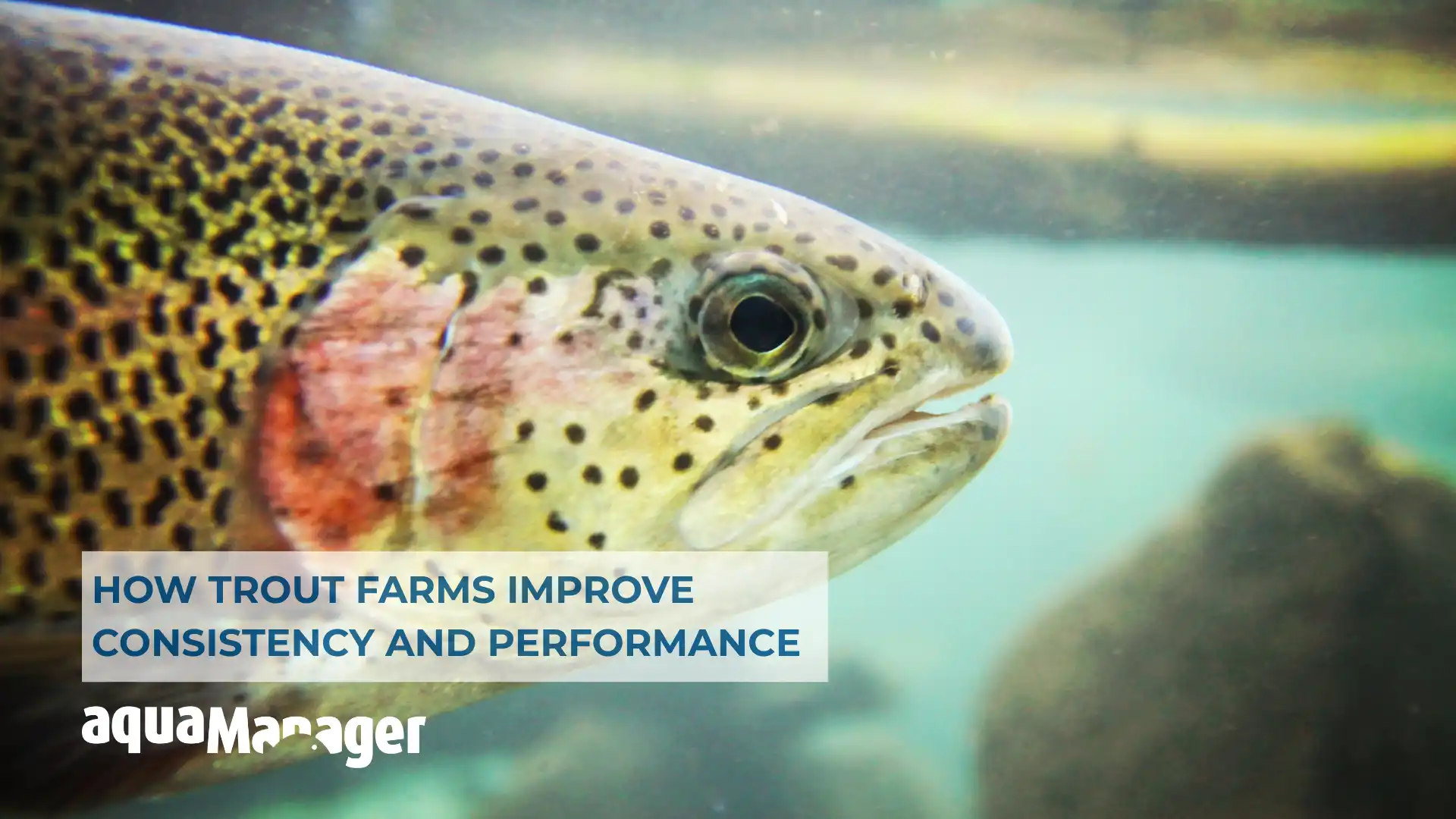
Trout farming demands precision. Temperature, handling routines, and timing can all affect survival, uniformity, and overall production performance. In hatcheries especially, small inconsistencies can quickly turn into measurable losses.
aquaManager is widely known for supporting aquaculture operations across multiple species, and it is also a strong fit for trout hatcheries and trout farms. It helps teams improve traceability, manage incubation progress with more predictability, and track growth performance with greater clarity. The result is a more controlled operation and better decision-making across the production cycle.
Hatchery traceability that supports repeatable results
In trout hatcheries, traceability is essential. Farms often manage multiple egg batches at the same time, and every stage matters: broodstock, incubation, hatching and the different developmental production stages of the fish (sac fry, first feeding, juvenile etc.). When records are spread across paper notes, Excel files, or informal team communication, it becomes difficult to maintain consistency and identify what changed when performance drops.
aquaManager supports structured hatchery traceability from egg collection to fry, so hatchery teams can record batch history in a clear and consistent way. This improves visibility across lots and incubators, and it helps managers compare outcomes over time. When survival rates or uniformity shift, traceability makes troubleshooting faster and more reliable, because the production history is easier to follow.
Incubation control based on degree-days (thermal units)
Trout incubation is strongly dependent on temperature. This is why many hatcheries plan incubation progress based on degree-days (thermal units), rather than calendar days alone. It is a practical way to align hatchery operations with biological development.
The challenge is that manual tracking can be inconsistent, especially when several batches are running in parallel. Hatch windows may shift, planning becomes harder, and teams risk missing key actions during critical stages.
aquaManager supports incubator monitoring and incubation planning based on degree-days, helping hatcheries follow progress with better predictability. This supports more consistent planning, clearer expectations for hatch timing, and smoother coordination across daily hatchery tasks. It also reduces reliance on individual experience alone, making operations easier to standardize across teams and shifts.
Performance visibility that supports better decisions
Trout farming performance is shaped by multiple, interconnected factors. Survival rates, hatchability, broodstock fertility, and growth performance all influence production outcomes, often across different stages of the cycle. When these indicators are monitored in isolation, or recorded inconsistently, farms struggle to understand what is driving results and where corrective action is needed.
aquaManager supports structured performance tracking across key biological and operational indicators, giving farms clearer visibility across production units and stages. Hatchery and farm teams can follow survival and hatchability trends, link broodstock performance to downstream results, and monitor growth in context rather than as a standalone metric. This creates a stronger basis for decisions related to feeding, handling, grading, and broodstock management.
Over time, this level of visibility supports continuous improvement. Performance trends become measurable and comparable across batches, tanks, and production cycles, allowing farms to move away from averages and assumptions and towards more informed, consistent decision-making.
Over time, this level of visibility supports continuous improvement. By combining consistent data capture, mobile access in daily operations, and advanced analytics (BI), farms gain a clearer view of performance trends across batches, units, and time periods. This enables more informed decisions and reduces reliance on assumptions or incomplete information.
What a structured system enables for trout farms
Visibility and consistency are not goals on their own. They are tools for improving biological and operational results.
When survival, hatchability, broodstock fertility, and growth performance are tracked accurately and consistently, farms gain a clearer and more reliable view of production. Survivability estimates become more precise, planning becomes more realistic, and decisions are based on actual performance rather than assumptions.
Over time, this allows farms to connect hatchery practices with grow-out outcomes. Results are no longer isolated by stage. Teams can identify what drives stronger fish quality, reduce unexpected losses, and improve consistency across batches. That is how structured data translates into better performance and more predictable operations.
aquaManager supports trout operations by bringing these workflows into one consistent system, helping farms improve control, reduce uncertainty, and operate more efficiently.
Talk to our experts to see how aquaManager fits your trout operation and how our experience across different farming models can support more predictable, data-driven decisions.